
Please don’t hesitate to contact me if you need a copy of any of my publications. Click the ➤ icon on any publication to see the abstract
Books
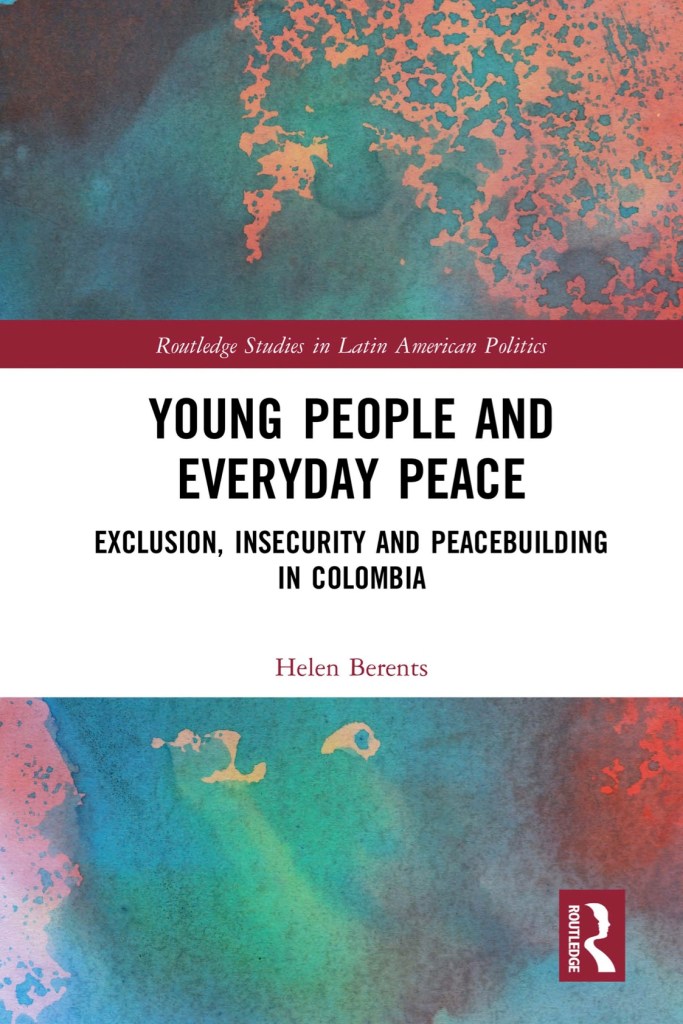
Berents H. 2018. Young People and Everyday Peace: Exclusion, Insecurity and Peacebuilding in Colombia. New York: Routledge
Young People and Everyday Peace is grounded in the stories of young people who live in Los Altos de Cazucá, an informal peri-urban community in Soacha, to the south of Colombia’s capital Bogotá. The occupants of this community have fled the armed conflict and exist in a state of marginalisation and social exclusion amongst ongoing violences conducted by armed gangs and government forces. Young people negotiate these complexities and offer pointed critiques of national politics as well as grounded aspirations for the future. Colombia’s protracted conflict and its effects on the population raise many questions about how we think about peacebuilding in and with communities of conflict-affected people.
Building on contemporary debates in International Relations about post-liberal, everyday peace, Helen Berents draws on feminist International Relations and embodiment theory to pay meaningful attention to those on the margins. She conceptualises a notion of embodied-everyday-peace-amidst-violence to recognise the presence and voice of young people as stakeholders in everyday efforts to respond to violence and insecurity. In doing so, Berents argues for and engages a more complex understanding of the everyday, stemming from the embodied experiences of those centrally present in conflicts. Taking young people’s lives and narratives seriously recognises the difficulties of protracted conflict, but finds potential to build a notion of an embodied everyday amidst violence, where a complex and fraught peace can be found.
Out in paperback 2020, click here for flyer with discount code
Lea la introducción de mi libro, Los Jóvenes y la Paz Cotidiana, en español aquí
Edited Books
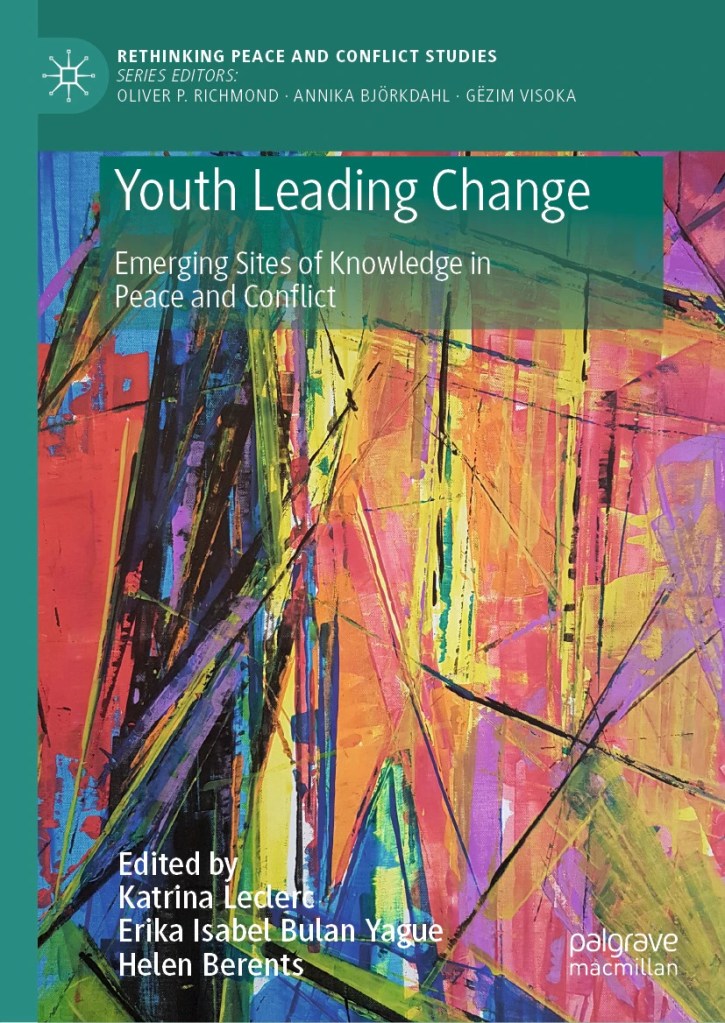
Leclerc, K, Yague, EIB, and and Berents, H. (eds). 2025. Youth Leading Change: Emerging Sites of Knowledge in Peace and Conflict. Palgrave.
Read the introduction here [pdf]
See Table of Contents here [pdf]
Watch the hybrid launch for the book (15 Oct 2025) and more information on other public events here.
This volume brings together young scholar-practitioners who draw on their own lived expertise and academic practice to examine how youth navigate complex socio-cultural and political conflicts, to bring about social and cultural change, creating space for positive peace despite decades of compounding crises. Contributors draw on expert knowledge and practice in a truly global range of contexts, covering Latin America and the Caribbean, Central and West Africa, Southeast Asia, the Middle East, and Eastern Europe. The specific insights of each chapter are situated in relation to the global policy architecture of the Youth, Peace and Security agenda, established by the UN Security Council, linking local and global contexts and extending limited but rapidly growing attention to youth as knowledge producers on peace and conflict.
Beier, M and Berents, H. (eds). 2023. Children, Childhoods, and Global Politics. Bristol: Bristol University Press.
Read the introduction here [pdf]
Read a short Q&A by Marshall and I at the Childhood, Law and Policy Network (CLPN)
Though children have never been absent from international studies discourse, they are too often reduced to a few simplistic and unidimensional framings. This book seeks to recover children’s agency and to recognize the complex variety of childhoods and the global issues that affect them. Written by an international list of contributors from Europe, Africa, North America, and Australasia, chapters present highly nuanced accounts of children and childhoods across global political time and space split into three broad sections: imagined childhoods, governed childhoods, and lived childhoods.Through its analysis, the book demonstrates how international relations is, somewhat paradoxically, quite deeply invested in a particular rendering of childhood as, primarily, a time of innocence, vulnerability, and incapacity.

Berents, H, Bolten C, and McEvoy-Levy S. (eds). 2024. Youth and Sustainable Peacebuilding. Manchester: Manchester University Press
Read the introduction here [pdf].
Sustainable peace involves more than simply including youth in official peacebuilding mechanisms or recognizing their local peacebuilding work; it requires a transformation in thinking about the youth as actors in the world of security and peace. Using case studies from around the globe, the contributors to this volume analyse why states are afraid of their young people, why ‘youth participation’ in formal peace processes matters but is insufficient, and ways that young people are working outside of official systems to create and nurture peace on their own terms. The volume offers guidance for ways to bridge the disconnect that exists between institutional assumptions and expectations for youth as peacebuilders and the actual sustainable peace leadership of youth. Throughout, it emphasises a critical approach to peacebuilding with, for and by youth.

Journal Articles
Berents, H, and Fosu, R. 2025. Constituting ‘Youth’: Conditionality and Compliance in UN Discourses on Youth, Peace and Security. Journal of Intervention and Statebuilding, 1–23, online-first [open-access]
The Youth, Peace and Security (YPS) agenda acknowledges youth as positive contributors to peace and security in contrast to dominant negative stereotypes of youth. This article examines constructions of youth within a dataset of UN documents on YPS to reveal discourses for normative change on youth inclusion. We identify four key framings of youth: as future leaders, as resources, as deficient, and as exceptional. We demonstrate that conditionality of youth inclusion fosters normative institutional compliance indicating the complexities of normative claims for the inclusion of excluded populations, persistence of unequal power relations, and politicisation of marginal groups for strategic gain.
Yague, IEB. and Berents, H. 2025. ‘The paradox of youth engagement: the role of young people in historical and contemporary Southeast Asian peace. The Pacific Review, 1–30, online-first [open-access]
Young people have been at the forefront of independence and peace movements across Southeast Asia. However, little scholarship has focused on their significant role and contribution to the region’s past and contemporary peace. They are often overlooked as political actors and agents of peace leading to their exclusion in consultations, decision-making and overall work in building and sustaining peace. In paying attention to and connecting historic events and contemporary context, a ‘paradox of youth engagement’ emerges. That is, the intriguing incongruity of institutional representatives who were once youth activists themselves who then grapple with the complexities of their past activism and the current limited spaces for youth engagement in institutional processes. Drawing on interviews with representatives from institutional regional peace and security mechanisms who were previously youth leaders in Southeast Asia we argue that understanding regional peace and security can be enhanced through attending to the overlooked role of youth and shifting relationships between youth and institutions. A recognition of the roles of young people historically can reveal their complexities and contradictions, highlighting the nuances of young people shifting positions within power hierarchies and systems. Such an analysis provides a deeper insight into ongoing struggles and the nature of institutionalisation of peace and security in the region.
Berents, H. 2025. ‘(Re)imagining childhood: provocations for a secure world beyond images of dead children.’ Critical Studies on Security, 1–3. Online-first [in Interventions section on ‘Children, childhoods, and security studies: taking stock and thinking forward’]
Berents, H. 2024. ‘What we give up to get where we’re going’: compromise in the institutionalizing of youth peace advocacy’. Globalizations. Online-first. [Open-Access] [In Special Issue The Politics of Child and Youth Representation in Global Governance: Confronting International Institutions’]
In 2015, the UN Security Council unanimously passed Resolution 2250 on Youth, Peace, and Security (YPS), formalizing an agenda for positive youth participation in peace and security. However, youth peace activists have been leading peacebuilding long before this institutional recognition. This article explores the dynamics of how advocates and institutional actors conceptualize and negotiate compromise. To do this, it draws on in-depth interviews with youth and adult YPS advocates, a critical analysis of documents related to the agenda, and extended participant observation. It explores and develops a notion of a field of youth-oriented peacebuilding, drawing on Bourdieu. This makes visible a more complex field of struggle, showing how compromise can help explain how youth actively negotiate their participation in formalized agendas and persist in their own peacebuilding ambitions. It argues for a more nuanced understanding of compromise to understand the affordances and limitations of youth agency and institutional agendas.
Berents, H, C Mollica, C Odgers-Jewell, H Payne, S Spalding. 2024. Conducting Care-full Research: Collaborative Research amidst Corona, a Coup, and Other Crises, International Studies Perspectives, online first [Open-Acess]
Abstract: Feminists have long called attention to often profoundly uneven power relations in international relations research, assumptions regarding who is able to be a “knowledge producer,” and the risks of extractive research. In research “on” and with young people, these dilemmas are compounded by ageist suppositions about youth competencies. This paper reflects on efforts by the authors to design and undertake a youth-led, adult-supported research project on youth activism and peace processes in South Sudan, Afghanistan, and Myanmar through virtual interviews. It discusses how our approach to skills training, mentorship, and research design empowers youth researchers to engage in dialogue with youth peacebuilders to establish a more collaborative research agenda. Centering collaboration offers opportunities for more responsive engagement with communities traditionally marginalized within the research environment. The global pandemic has raised questions about research at a distance, the requirements of “participation,” and the ethics of reciprocity with research participants as knowledge producers. In each case, challenges raised difficult questions about the ethics of pursuing research in these complex contexts. We offer the idea of care-full research that centers a feminist, reflexive approach, is collaborative in multiple ways, and generates new possibilities for knowledge creation amidst multiple crises and beyond.
Berents, H. 2022. ‘Power, Partnership, and Youth as Norm Entrepreneurs: Getting to UN Security Council Resolution 2250 on Youth, Peace, and Security’, Global Studies Quarterly, 2(3): ksac038 [Open-access]
Abstract: Advocates have long worked within and outside the United Nations (UN) to institutionalize recognition of youth as positive participants in peace and security. However, despite the disproportionate impact of conflict on youth, attention to constructive role of youth in peacebuilding has been largely neglected. In 2015, a convergence of efforts and events saw the UN Security Council pass a groundbreaking thematic resolution, Resolution 2250 on Youth, Peace, and Security (SCR2250), which recognizes for the first time youth’s positive role in responding to peace and security challenges. This article draws on analysis of civil society and UN documents, and interviews with key members of the coalition of UN and civil society actors who advocated for this resolution. It demonstrates that partnership with youth in the case of Youth, Peace and Security (YPS) advocacy offers an opportunity to extend understandings of agenda setting in new ways. It examines the issue framing as well as the actors, access, and allies that enabled the success of a coalition of diverse actors working toward normative change. Efforts toward SCR2250 were unique because of the key role of youth-led advocacy, making youth themselves central not only as beneficiaries but also as creators of a new principle for the norm of youth participation in peace and security.
Berents, H. 2020. ‘Politics, policy-making and the presence of images of suffering children’, International Affairs, 96(3): 593–608.
Abstract: In 2017 Trump expressed pity for the ‘beautiful babies’ killed in a gas attack on Khan Shaykhun in Syria before launching airstrikes against President Assad’s regime. Images of suffering children in world politics are often used as a synecdoche for a broader conflict or disaster. Injured, suffering, or dead; the ways in which images of children circulate in global public discourse must be critically examined to uncover the assumptions that operate in these environments. This article explores reactions to images of children by representatives and leaders of states to trace the interconnected affective and political dimensions of these images. In contrast to attending to the expected empathetic responses prompted by images of children, this article particularly focuses on when such images prompt bellicose foreign policy decision-making. In doing this, the article forwards a way of thinking about images as contentious affective objects in international relations. The ways in which images of children’s bodies and suffering are strategically deployed by politicians deserves closer scrutiny to uncover the visual politics of childhood inherent in these moments of international politics and policy-making.
Berents, H. and Duncombe, C. 2020. ‘Introduction: Violence, Visuality and World Politics’, International Affairs, 96(3): 567-571. [Introduction to Special Section on ‘Violence, Visuality and World Politics’]
Abstract: Visuals are powerful mediators of global political events. Images, moving and still alike, are significant objects that play a role in shaping our understanding of international affairs. Through their multiple interpretations, these visuals can both represent reality and condition how we understand it. Within International Relations, there has been growing attention to the visual, with explorations of a wide range of theoretical concerns and empirical focuses. For instance, contributors to the burgeoning field of visual politics examine the affective power of images, how images become securitized and their role in framing politics.
Yet to date sustained attention has not been paid to the links between violence, images of violence and the effects of those images on policy-making. This special section draws on rich conversations in visual politics, alongside other disciplinary contributions, to pay particular attention to the co-constitution of visuality and violence in world politics. Visuals, whether still images or film and video, can help increase our field of view and make us aware of the many forms and manifestations of violence and its effects. The special section of this issue of International Affairs examines how images are implicated in direct and indirect violence, how emotional logics contribute to the political function of images, and furthermore how violent images inform the ways in which communities, policy-makers and scholars see and respond to complex political problems.
Berents, H. 2020. “This is my story”: Children’s war memoirs and challenging protectionist discourses’, International Review of the Red Cross, 101(911, Children and war): 459-479
Abstract: Protectionist frames of children as passive, uncomprehending victims characterize the international architecture of responding to children in war. However, stories such as those in children’s war memoirs draw attention to the agency and capacity of children to negotiate and navigate distinct traumas and experiences in war. Children experience particular vulnerabilities and risks in conflict zones and their potential as contributors to the solutions to war must also be taken seriously. Children’s authoritative voices in memoir writing reveal the limitations of protectionist-dominated approaches and offer a rationale for taking the participatory elements of international humanitarian mechanisms and responses to conflict more seriously. Such a move may help address the comprehensive silencing of children’s voices in the institutional architecture concerned with children in war.
Berents, H and Keogh, B. 2019. “Dominant, damaged, disappeared: imagining war through videogame bodies”. Australian Journal of Political Science. 54(4): 515-530. [In Symposium on ‘Exploring the (Multiple) Futures of World Politics Through Popular Culture’]
Abstract: Like other pop-cultural forms, videogames commonly reify militarist representations of warfare as straightforward, precise, and moral by obscuring conflict’s embodied messiness. But videogames do not just reflect militarist interests in their content; they are materially, symbiotically entangled with militarist interests. Recognising this intimate connection, and the phenomenon of virtuous warfare that results, this paper takes videogames seriously as material cultural artefacts. This paper draws on feminist IR, critical military studies, and game studies to explore three categories of bodies, and their gendered logics, produced by virtualised warfare: the hypermasculine, technologised soldier; the oft-ignored broken bodies of the soldier and game developer; and the obfuscated civilian. Together, this analysis argues that the consumption and production of videogames benefits certain parties, in ways that are reproduced and sustained through the production and obfuscation of bodies. Such entanglements have real consequences for how war, and its popular culture production, is understood and imagined.
O’Brien, E and Berents, H. 2019. “Virtual Saviours: Digital games and anti-trafficking awareness-raising”. Anti-Trafficking Review. 13: 82-99. [Open-access]
Abstract: In recent years, digital games have emerged as a new tool in human trafficking awareness-raising. These games reflect a trend towards ‘virtual humanitarianism’, utilising digital technologies to convey narratives of suffering with the aim of raising awareness about humanitarian issues. The creation of these games raises questions about whether new technologies will depict humanitarian problems in new ways, or simply perpetuate problematic stereotypes. This article examines three online games released in the last five years for the purpose of raising awareness about human trafficking. In analysing these games, we argue that the persistent tropes of ideal victims lacking in agency continue to dominate the narrative, with a focus on individualised problems rather than structural causes of human trafficking. However, the differing approaches taken by the games demonstrate the potential for complexity and nuance in storytelling through digital games.
Berents, H. 2019. “Apprehending the ‘Telegenic Dead’: Considering Images of Children in Global Politics”. International Political Sociology. 13(2): 145-160. [Open-access]
Abstract: Images of suffering children have long been used to illustrate the violence and horror of conflict. In recent years, it is images of dead children that have garnered attention from media audiences around the world. In response to the deaths of four children killed by the Israeli army while playing on a Gazan beach, Israeli Prime Minister Netenyahu accused Hamas of generating “telegenically dead” Palestinian children for their cause (CNN 2014). In this article, it argues with this term to consider the appearance of images of dead children in global politics. I draw on a growing literature relating to the corpse as a subject in international relations (IR), asking how children’s bodies are understood, following Butler, as “grievable lives.” It explores the notion of “iconic” images and the politics of sharing images of dead bodies and consider global power relations that allow certain children’s deaths to be visible and not others. Through this analysis, the article argues that the idea of telegenic death might be productively considered to understand how the fleshy reality of children’s deaths contribute to discussions about the representation and visibility of children in contexts of crisis and conflict.
Pruitt, L, Berents H, and Munro G. 2018. “Gender and Age in the Construction of Male Youth in the European ‘Migration Crisis”. Signs: Journal of Women and Culture in Society [Special issue on ‘Displacement’] 43(3): 687-709 [pdf]
Abstract: Displacement is clearly gendered; age also has a strong influence on outcomes and experiences for the displaced, including a significant impact on how they are understood by the public and policy makers. It is important to keep this in mind when considering how children and youth are understood within contexts of conflict and insecurity, how they are affected by these forces, and how they navigate their lives in these contexts, especially in seeking peaceful outcomes. Here we engage with the current so-called European migration crisis as a potential watershed moment in understandings of children and youth as refugees. In particular, we suggest that the public representations of young people in this context can be deeply influenced by stereotypes and assumptions around gender and age that may—intentionally or inadvertently—lead to greater insecurity for people of diverse genders and ages. Likewise, we argue that when considering scholarship, policy, and practice in relation to migration, it is critical to develop and apply a lens that accounts for both gender and age.
Berents, H and Keogh, B. 2018. “Virtuous, Virtual, but not Visceral: (Dis)embodied Viewing in Military-themed Videogames” Critical Studies on Security. [In ‘Intervention’ section on: Visual representations of war and violence: considering embodiment]
Abstract: The dominant visual representation strategies of warfare through the virtual bodies of military-themed first-person shooter videogames obscures the corporeal embodied experiences of warzones. These games typically reinforce certain representational schema in which only certain kinds of bodies are visible. This article argues that the multi-million dollar videogame industry is intimately connected to institutional practices of war-making in the global order, and that it is crucial to pay attention to the embodied consequences of such a relationship.
Berents, H and ten Have, C. 2017. “Navigating Violence: Fear and Everyday Life in Mexico and Colombia”. Crime, Justice and Social Democracy Journal. 6(1): 103-117. [Open-access]
Abstract: Violence and insecurity are often read as totalising narratives of communities in parts of Latin America, flattening the complexity of everyday life and the responses of occupants who suffer from fear. In this article we draw on ethnographic research undertaken in los Altos de Cazucá in Colombia and in San Luis Potosí in Mexico. While both sites are distinct locations with different historic, economic, social and political contexts they share features of communities affected by violence and insecurity: distrust of institutions of the state; rationalisations for managing violence in daily life; and narratives of fear that appear woven through the fabric of conversations. However, fear and violence are not all-encompassing experiences and individuals in both these communities describe practices of navigation of violence that draw on positive communal experiences. This article explores how, in these communities where violence comes to be expected but never normalised, people navigate their everyday lives.
Berents, H. 2016. “Hashtagging Girlhood: #IAmMalala, #BringBackOurGirls, and gendering representations of global politics”. International Feminist Journal of Politics 18(4): 513-527. [Winner of the 2015 Cynthia Enloe Award, awarded to an article by an exceptional early career scholar]
Abstract: This article explores how gendered, racial and youth-ed concepts of girlhood shape the way conflict, violence and the lived experiences of girls in conflict-affected environments are understood globally. In particular, it examines the broader context and effect of social media campaigns that specifically invoke a concept of “girlhood” in their responses to crisis or tragedy. It focuses on two hashtags and their associated social media campaigns: #IAmMalala, started in response to the attempted killing of Pakistani education activist Malala Yousafzai in 2012 by Taliban gunmen, and #BringBackOurGirls, started by Nigerians and adopted globally in response to the kidnapping of 276 schoolgirls by terrorist group Boko Haram. In both instances, understandings of the broader political context are shaped by the focus on girls. Both hashtags also appropriate an experience: claiming to be Malala and claiming the Nigerian girls as ours. Through this exploration, I argue that particular ideals of girlhood are coded within these campaigns, and that these girls’ experiences are appropriated. I critique the limited representations of girlhood that circulate in these discussions, and how these limited representations demonstrate the problematic narrowness of dominant conceptions of girlhood.
Berents, H. & McEvoy-Levy, S. 2015. “Theorising youth and everyday peace(building)”. Peacebuilding, 3(2): 1-14. [Open-access]
Abstract: The introductory essay presents a locally-grounded theoretical framework for studying youth and everyday peace(building). Drawing on examples from fieldwork as well as insights from the articles to follow in the journal, the essay highlights three interrelated and overlapping spheres of inquiry. First, it makes the case for examining the age-specific as well as gender-, and other contextually-specific roles of youth as they relate to everyday peacebuilding. Second, the essay draws attention to how everyday peace is narrated by or through youth. It poses questions about what values, policies, and governmental structures are specifically being resisted and rejected, and how peace is conceptualised and/or hidden in the narratives of youth. Third, along with these concerns, the nexus of global and local (including discursive and institutional) structures that facilitate, curtail, and curtain everyday peace (building) practices are important to identify and evaluate for their impacts on the roles and ideas of youth. In proposing this theoretical framework that recognises the complex and multiple ways youth are engaged in their everyday worlds, this essay asks how we can engage this recognition within knowledges and practices of everyday peace(building).
Berents, H. 2015. “An embodied everyday peace in the midst of violence”. Peacebuilding, 3(2): 115-125 [special issue on Youth and Everyday Peace, edited by myself and Siobhan McEvoy-Levy]
Abstract: Orthodox notions of peace built on liberal institutionalism have been critiqued for their lack of attention to the local and the people who populate these structures. The concept of an ‘everyday peace’ seeks to take into account the agency and activity of those frequently marginalised or excluded and use these experiences as the basis for a more responsive way of understanding peace. Furthermore, reconceptualising and complicating a notion of ‘everyday peace’ as embodied recognises marginalised people as competent commentators and observers of their world, and capable of engaging with the practices, routines and radical events that shape their everyday resistances and peacebuilding. Peace, in this imagining, is not abstract, but built through everyday practices amidst violence. Young people, in particular, are often marginalised or rendered passive in discussions of the violences that affect them. In recognising this limited engagement, this paper responds through drawing on fieldwork conducted with conflict-affected young people in a peri-urban barrio community near Colombia’s capital Bogota to forward a notion of an embodied everyday peace. This involves exploring the presence and voices of young people as stakeholders in a negotiation of what it means to build peace within daily experience in the context of local and broader violence and marginalisation. By centring young people’s understandings of and contributions within the everyday, this paper responds to the inadequacies of liberal peacebuilding narratives, and forwards a more complex rendering of everyday peace as embodied.
Berents, H. 2015. “Children, violence, and social exclusion: Negotiation of everyday insecurity in a Colombian barrio”. Critical Studies on Security, 3(1): 90-104. [special issue on Children, Childhoods, and Security Studies]
Abstract: Discourses on in/security are often concerned with structures and meta-narratives of the state and other institutions; however, such attention misses the complexities of the everyday consequences of insecurity. In Colombia’s protracted conflict, children are disproportionately affected yet rarely consulted, rendering it difficult to account for their experiences in meaningful ways. This article draws on fieldwork conducted with conflict-affected children in an informal barrio community on the periphery of Colombia’s capital, Bogotá, to explore how children articulate experiences of insecurity. It examines how stereotypes of violence and delinquency reinforce insecurity; how multiple violences impact young people’s lives; and how children themselves conceive of responses to these negative experiences. These discussions are underpinned by a feminist commitment of attention to the margins and engage with those for whom insecurity is a daily phenomenon. The effects of deeply embedded insecurity, violence, and fear for young people in Colombia require a more nuanced theoretical engagement with notions of insecurity, as well as the complexities of connections and dissonances within everyday life.
Berents, H. 2014. “‘Its about finding a way’: Children, sites of opportunity, and building everyday peace in Colombia”. International Journal of Children’s Rights. 22(2): 362-384
Abstract: The multiple forms of violence associated with protracted conflict disproportionately affect young people. Literature on conflict-affected children often focuses on the need to provide stability and security through institutions such as schools but rarely considers how young people themselves see these sites as part of their everyday lives. The enduring, pervasive, and complex nature of Colombia’s conflict means many young Colombians face the challenges of poverty, persistent social exclusion, and violence. Such conditions are exacerbated in ‘informal’ barrio communities such as los Altos de Cazucá, just south of the capital Bogotá. Drawing on field research in this community, particularly through interviews conducted with young people aged 10 to 17 this article explores how young people themselves understand the roles of the local school and ngo in their personal conceptualisations of the violence in their everyday lives. The evidence indicates that children use spaces available to them opportunistically and that these actions can and should be read as contributing to local, everyday forms of peacebuilding. The ways in which institutional spaces are understood and used by young people as ‘sites of opportunity’ challenges the assumed illegitimacy of young people’s voices and experiences in these environments.
Berents, H. 2009. “No Child’s Play: Recognising the agency of former child soldiers in peace building processes”. Dialogue 6(2): 1-35 [pdf]
Book Chapters
Leclerc, K., EIB Yague and H Berents. 2025. Young People as Movers and Shakers of Peace and Security. In Leclerc, K., EIB Yague and H Berents (eds). Youth Leading Change. Palgrave. [pdf]
Berents, H. 2024. Everyday Peace. In Mac Ginty, R. (ed). Routledge Handbook of Peacebuilding, 2nd edition. New York: Routledge. [pdf]
Berents, H. C Bolten, and S McEvoy-Levy 2024. Introduction: Youth and Sustainable Peace. In Berents H, C Bolten, S McEvoy-Levy (eds). Youth and Sustainable Peace. Manchester: Manchester University Press. [pdf]
Berents, H. 2024. Institutionalising a Radical Vision: The Idea of Youth and the Youth, Peace and Security Agenda. In Berents H, C Bolten, S McEvoy-Levy (eds). Youth and Sustainable Peace. Manchester: Manchester University Press. [pdf]
Beier, M and Berents, H. 2023. “Introduction: Children and Childhoods in Global Political Perspective” In Beier, M and Berents, H. (eds). Children, Childhoods, and Global Politics. Bristol: Bristol University Press. [pdf]
Altiok, A, Berents, H, Grizelj, I, & McEvoy-Levy, S. 2020. Youth, Peace, and Security. In Hampson, F O, Özerdem, A, & Kent, J (Eds.) Routledge Handbook of Peace, Security and Development. Routledge, Abingdon, Oxon, pp. 433-447.
Berents, H. 2020. Depicting childhood: A critical framework for engaging images of children in IR. In Beier, J.M. (Ed.) Discovering Childhood in International Relations. Palgrave Macmillan, Cham, Switzerland, pp. 41-63.
Berents, H & Mollica, C. 2020. Youth and peacebuilding. In Richmond, O & Visoka, G (Eds.) The Palgrave Encyclopedia of Peace and Conflict Studies. Palgrave Macmillan, Cham.
Berents, H. 2018. “Right(s) from the Ground Up: Internal Displacement, the Urban Periphery and Belonging to the City” In Agius, C and Keep D (eds) The Politics of Identity: Space, Place and Discourse. Manchester: Manchester University Press
Berents, H and ten Have, C. 2018. “Staying Safe in Colombia and Mexico: Skilled Navigation and Everyday Insecurity”. In Carrington, K, Scott, J and Hogg, R (eds) Palgrave Handbook on Criminology and the Global South. Palgrave. [pdf]
Berents, H. 2012. “Hermione Granger goes to war: A feminist reflection on the situation of girls in real world conflicts”. In C. Bell (ed.) Hermione Granger Saves the World: Essays on the Feminist Heroine of Hogwarts. McFarland & Company, Jefferson, NC and London. (142-162).
Reports
Spalding S, Odgers-Jewell C, Payne H, Mollica C & Berents H. 2021. Making Noise and Getting Things Done: Youth Inclusion and Advocacy for Peace. Lessons from Afghanistan, South Sudan, and Myanmar. QUT Centre for Justice. December. [see Project Page for more details]
Berents, H & Prelis, S. 2020. More than a Milestone: The Road to UN Security Council Resolution 2250. Search for Common Ground.
Berents, H & Mollica, C. 2020. Youth and Peace in the Indo-Pacific: Policy, Practice, Action: Report on the Academy of Social Science in Australia (ASSA) Workshop. QUT Centre for Justice.
Reviews
Berents, H. 2024. Hustling for Peace: A Review of Best Man Corner, directed by Jaremey McMullin, 2019. Civil Wars.
Berents, H. 2017. “Book Review: Child Security in Asia: The Impact of Armed Conflict in Cambodia and Myanmar by Celia Jacob”. Global Governance.
Berents, H. 2015. “Book Review: Gender and Global Justice” Australian Journal of Politics and History. 61(1): 165-166.
Special Issues editorship
Berents, H & C Duncombe (eds). 2020. Special section on ‘Violence, Visuality and World Politics’ for International Affairs 96(3).
Berents, H & S McEvoy-Levy (eds). 2015. Special issue on “Everyday Peace and Youth” for Peacebuilding 3(2).
[Back to Writings & Media]
(last updated 10 Sept 2025)
 Helen Berents